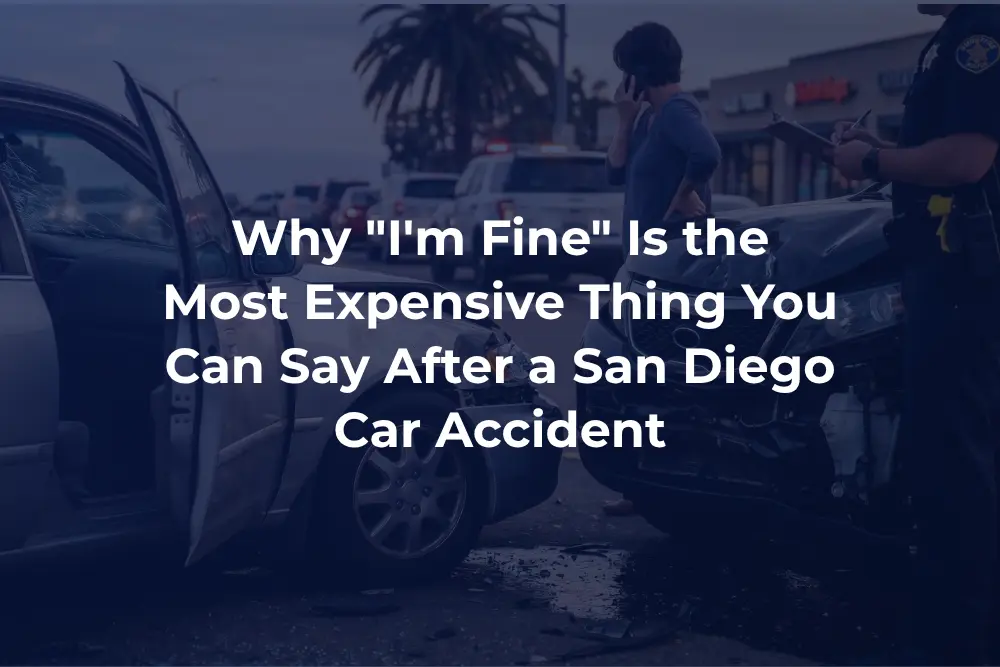
Two words. Said out of politeness. Said out of shock. Said because someone asked and your brain didn’t know what else to do.
“I’m fine.”
If you said it at the scene of a car accident in San Diego, you said it before your body knew the truth. And every insurance adjuster handling your claim is hoping you said it more than once.
Here’s the uncomfortable reality of personal injury law in 2026: the first 72 hours after a crash decide a huge amount of your case value, and the language you use during those 72 hours can hand the insurance company everything they need to underpay you. Sometimes by tens of thousands of dollars.
Your Body Is Lying to You for the First 48 Hours
When a car hits you, your nervous system dumps adrenaline and endorphins into your bloodstream. That’s not opinion. That’s biology. Adrenaline shuts down pain signals so you can move, react, and survive. Endorphins do the same thing for emotional shock.
Translation: you literally cannot feel most of your injuries at the scene. Your body is hiding them from you on purpose.
Adrenaline typically wears off within 24 to 48 hours. Once it does, swelling kicks in. Inflammation builds. Nerves that were quiet start firing. And the pain you didn’t feel at the scene becomes the pain that wakes you up at 3 a.m. three nights later.
If you said “I’m fine” while adrenaline was still running your body, you were telling the truth about how you felt. You were not telling the truth about what was actually happening inside your spine, your neck, or your brain.
The Injuries That Show Up Late
These are the injuries that almost always have a delay between the crash and the symptoms:
- Whiplash and cervical strain. Symptoms surface 24 to 48 hours after impact. Stiffness, headaches, reduced range of motion, jaw pain, even ringing in the ears.
- Concussion and mild traumatic brain injury. Memory issues, mood swings, sensitivity to light, sleep disturbance. These can take days or weeks to fully appear. About 24 percent of mild TBI patients still have symptoms a year out.
- Herniated and bulging discs. Often invisible on the day of the crash. Become unmistakable two weeks later when shooting nerve pain runs down your leg.
- Internal bleeding and abdominal trauma. Can develop slowly over hours. This one is dangerous, not just expensive. Get checked.
- Soft tissue and ligament damage. Knees, shoulders, wrists. Sprains and tears often present as soreness on day one and become full-blown disability by day five.
- PTSD, anxiety, and sleep disorders. Often start days or weeks after the crash. Compensable in California. Routinely missed.
None of these conditions are scams. They are documented, well-studied, and treated every day at Sharp, Scripps, Kaiser, and every urgent care in San Diego County. The science is on your side. The problem is, the insurance adjuster on the other end of the phone is going to act like it isn’t.
How “I’m Fine” Becomes a Weapon in Your Claim
The moment your case lands on an adjuster’s desk, they are looking for three things:
- A reason to argue you weren’t really hurt.
- A reason to argue your injuries came from something else.
- A reason to argue you waited too long, so the crash couldn’t have caused it.
“I’m fine” gives them all three at once.
It shows up in the police report. It shows up in witness statements. It shows up in recorded statements if you give one. It shows up if you posted on Instagram that night. And once it’s in the file, the adjuster’s argument writes itself: “Even the claimant said they were fine. The medical complaints didn’t appear until four days later, which suggests an unrelated cause.”
That argument may not win at trial. But it doesn’t have to. It just has to scare you into accepting a lowball settlement.
The Recorded Statement Trap
Within 48 hours of your accident, you will probably get a call from the other driver’s insurance company. The adjuster will be polite. Sometimes warm. They will tell you they just need a quick recorded statement to “process your claim.”
This is not routine. It is a trap.
Adjusters are trained to ask questions designed to:
- Lock you into a version of events before you have all the facts
- Get you to say “I’m fine” or “I feel okay” while it’s still being recorded
- Trick you into minimizing pain (“It’s just a little sore”)
- Catch you contradicting something a witness already said
- Get you to speculate about the speed, distance, or fault, then use your guess against you
You are not legally required to give a recorded statement to the other driver’s insurer. Ever. If they push, the answer is simple: “I’ll have my attorney follow up with you.” That’s it. End of call.
Your own insurer is a different story. You may have a contractual obligation to cooperate, but even then, do it through your lawyer.
Your Instagram Account Is Now Evidence
Roughly 45 percent of insurance claim investigations now involve a social media review. AI tools scan thousands of posts in seconds. They flag photos, captions, geotags, even the angle of your body in a selfie.
Here’s what gets weaponized:
- A photo of you at a Padres game smiling (“clearly mobile and pain-free”)
- A video of you dancing at a quinceañera (“full range of motion”)
- A caption that says “feeling great” or “good day today” (“no pain or limitation”)
- Check-ins at the gym, the beach, Balboa Park, Liberty Station, anywhere active
- Photos of you lifting your kid, carrying groceries, walking your dog
Some insurers also create fake “sock puppet” friend requests to see private posts. If you accept the request, that content is fair game.
None of this means you can’t live your life. It means while your claim is open, every public post is a potential exhibit at trial.
Rule of thumb during an active claim: if you wouldn’t print it on a t-shirt and wear it into court, don’t post it.
What to Say Instead, at the Scene
Nobody is asking you to fake injuries. Nobody is asking you to lie. The goal is to stop making confident statements about a body that just took an impact and is currently flooded with adrenaline.
Better answers when someone (a witness, the other driver, a cop, a paramedic) asks if you’re hurt:
- “I’m not sure yet. I want to get checked out.”
- “I have some pain, but I don’t know how bad it is.”
- “My neck and back feel tight. I’d like to see a doctor.”
- “I don’t want to say until I’ve been examined.”
If a paramedic offers to evaluate you on scene, let them. Refusing medical care at the scene is the second worst thing you can do for your claim. The first is saying “I’m fine” while waving them off.
The 72-Hour Rule
If you do nothing else right after a San Diego car accident, do this:
- Get medical attention the same day. Go to Scripps Mercy, Sharp Memorial, UC San Diego Health, Kaiser, or any urgent care. Even if you feel okay. Especially if you feel okay.
- Document every symptom in writing for the first 14 days. Notes on your phone are fine. Date, time, what hurts, how bad. This becomes part of your evidence.
- Don’t talk to the other side’s insurance. Don’t give a recorded statement. Don’t speculate about fault. Don’t agree to a quick settlement before you’ve seen a doctor twice.
- Lock down your social media. Switch accounts to private. Don’t post about the accident. Don’t post photos that could be misread as physical activity. Tell friends not to tag you.
- Call a San Diego personal injury lawyer before you agree to anything. Consultations are free. The cost of doing this wrong is enormous.
Gaps in Care: The Silent Case Killer
There’s a second mistake almost as costly as saying “I’m fine.” It’s letting weeks pass between medical visits.
Insurance adjusters treat gaps in care as proof that the injury wasn’t serious. If your records show an ER visit on day one, no follow-up for three weeks, and then a chiropractor appointment on week four, the adjuster’s argument is that whatever’s hurting you on week four wasn’t caused by the crash.
That’s not how human bodies actually work. Pain has cycles. People power through. People can’t get off work. People don’t have insurance. None of that matters to the adjuster. What matters is the paper trail.
Consistent treatment, week after week, with the same provider or coordinated providers, is what turns a $20,000 case into a $200,000 case. It is the single biggest piece of leverage in negotiation.
How The Cruz Law Office Protects San Diego Injury Clients From Day One
When you call us in the first 72 hours after a crash, here’s what changes:
- All insurance communication goes through us. You don’t talk to adjusters. We do. No recorded statements, no “quick questions,” no traps.
- We coordinate medical care. Orthopedists, chiropractors, neurologists, pain management. Many treat on a lien so you don’t pay out of pocket while your case is pending.
- We document the delayed symptoms in real time. Symptom journals, follow-up exams, imaging. The kind of paper trail adjusters can’t argue with.
- We coach you on social media. What to take down, what to keep private, and what never to post until the case closes.
- We rebut the “I’m fine” problem head-on. If you already said it, it’s not the end of the case. We frame it with medical evidence and the adrenaline science that explains why it was meaningless.
Free consultations. No fee unless we recover. English or Spanish.
Frequently Asked Questions
Adrenaline masks injury for 24 to 48 hours after a crash. Saying “I’m fine” at the scene is captured in police reports, witness statements, and adjuster recordings, and is later used to argue your injuries came from somewhere else. Many serious injuries, including whiplash, concussions, and herniated discs, don’t show symptoms until days later.
Typically 24 to 48 hours. The adrenaline and endorphin response shuts down pain signals so you can move and react after a crash. Once those hormones fade, inflammation and nerve pain begin. That’s why so many car accident injuries feel worse on day two or three than they did at the scene.
Yes. You cannot delete what was said, but you can document the truth in medical records starting the same day. A clear pattern of medical visits, imaging, and consistent symptom reporting from day one onward will outweigh a single statement made at the scene under shock conditions.
No. You are not legally required to give a recorded statement to the at-fault driver’s insurer. Politely decline and refer them to your attorney. Recorded statements are designed to find inconsistencies and lock you into versions of events before your full injuries appear.
Yes. About 45 percent of claim investigations now involve a social media review, and AI tools scan thousands of posts at a time. Photos, captions, geotags, even check-ins can be used to argue you aren’t really injured. Set accounts to private and stop posting until your case closes.
Under California Code of Civil Procedure section 335.1, you have two years from the date of the accident to file a personal injury lawsuit. If a government vehicle is involved, you must file a tort claim within six months. The practical deadline to start building the case is the same week as the crash.
Delayed onset is normal and well-documented in medical literature. Whiplash, concussion symptoms, disc injuries, and PTSD can all surface days or weeks later. The key is getting examined as soon as symptoms appear and creating a continuous medical record that connects them back to the crash.
Yes. Insurance adjusters treat gaps in care as proof that injuries weren’t serious. Consistent treatment, with the same provider or a coordinated team, is one of the strongest factors in case value. Even a two to three week gap can be used to reduce your settlement.
Try “I’m not sure yet, I want to get checked out,” or “I have some pain, but I don’t know how bad it is.” Honest uncertainty protects your claim. Accept any offered paramedic evaluation. Avoid making confident statements about your physical condition until a doctor has examined you.
Yes. We routinely represent San Diego clients whose injuries emerged hours or days after the crash. We document the medical timeline, coordinate ongoing treatment, and rebut adjuster arguments built around “I’m fine” statements. Consultations are free, in English or Spanish, no fee unless we win.
Already Said “I’m Fine”? It’s Not Too Late.
The Cruz Law Office handles personal injury claims across San Diego County: from downtown, Pacific Beach, and Hillcrest to Chula Vista, El Cajon, La Mesa, and North County. We know how to reframe early statements, document delayed injuries, and push back on adjuster tactics. Bilingual team. No fee unless we recover.
Call (626) 507-2695 • Free Consultation • Hablamos Español
Legal disclaimer: This article is for general information only and does not create an attorney-client relationship. Every case is different. Past results do not guarantee future outcomes.