Human trafficking survivors often carry much more than the memory of what happened to them. They may carry fear, trauma, shame, anxiety, nightmares, depression, or fear of being hurt or exploited again.
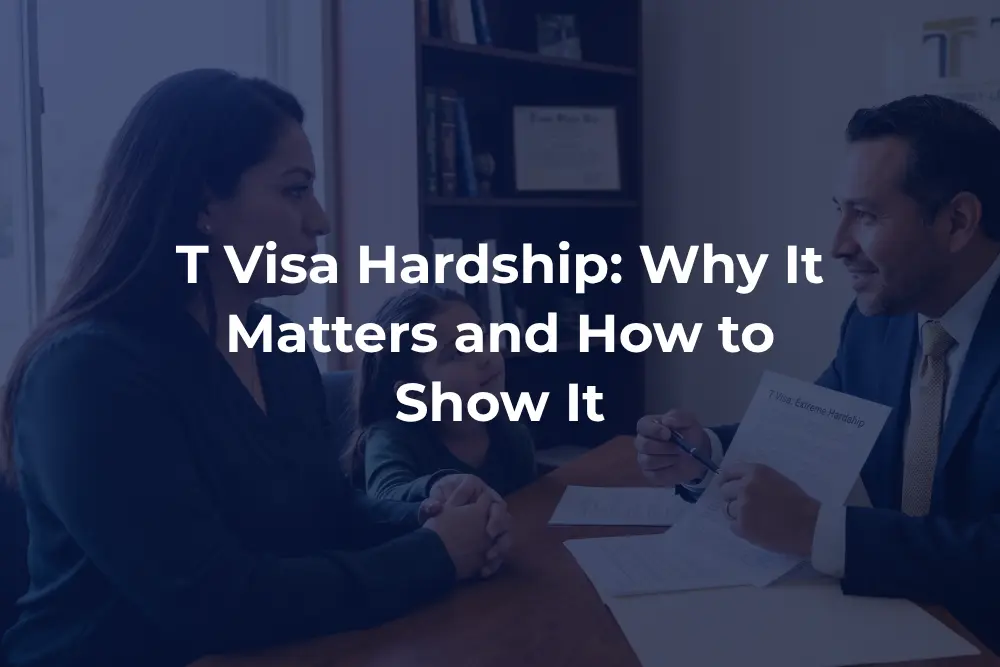
For a T Visa case, it is not enough to only explain that trafficking happened. A person applying for a T Visa must also show that being removed from the United States would cause extreme hardship involving unusual and severe harm.
That is why hardship is one of the most important parts of a T Visa case.
At The Cruz Law Office, we believe immigrants are heroes. Many immigrants have survived danger, sacrifice, exploitation, separation, and fear while still trying to protect their families and build a future. During our attorney-led consultations, we use what we call the HERO Method to help understand the story and identify possible legal options:
- H — Harm: What happened to you? What abuse, exploitation, threats, coercion, or trauma did you suffer?
- E — Evidence: What proof may exist? This may include your declaration, therapy records, text messages, work records, witnesses, reports, or country conditions.
- R — Relief: What immigration protection may fit your facts? For some survivors, this may include a T Visa.
- O — Opportunity: What future may become possible if the case is prepared carefully and the person receives protection?
This method helps us look at the person, the harm, the evidence, and the possible legal path forward.
What Is a T Visa?
A T Visa is an immigration protection for certain victims of severe forms of human trafficking.
Human trafficking can involve labor exploitation, sex trafficking, involuntary servitude, debt bondage, peonage, slavery, or other situations where a person was forced, defrauded, or coerced into labor, services, or commercial sex.
T Visa cases are not simple form filings. They require a careful legal review of what happened, how it happened, why it may qualify as trafficking, and what evidence can support the case.
Basic Requirements for a T Visa
A principal T Visa applicant generally must show several things.
First, the person must be or have been a victim of a severe form of trafficking in persons.
Second, the person must be physically present in the United States, American Samoa, the Northern Mariana Islands, or at a port of entry on account of the trafficking.
Third, the person must have complied with any reasonable request for assistance from law enforcement, unless an exception applies. For example, certain minor victims or survivors who cannot cooperate because of trauma may qualify for an exception.
Fourth, the person must show that removal from the United States would cause extreme hardship involving unusual and severe harm.
Fifth, the person must be admissible to the United States or qualify for a waiver of inadmissibility.
Each requirement matters. But this article focuses on one requirement that many people do not understand at first: T Visa hardship.
Where Does Hardship Fit in a T Visa Case?
Hardship is a required part of a T Visa case. It is not just an extra argument or emotional background.
A T Visa applicant must show that removal from the United States would cause extreme hardship involving unusual and severe harm. In simple terms, USCIS wants to understand what serious harm could happen to this particular survivor if they were forced to leave the United States.
Hardship should answer questions like:
- What does the survivor still suffer because of the trafficking?
- Does the survivor have trauma, anxiety, depression, nightmares, panic attacks, or fear?
- Is the survivor receiving therapy, medical care, or other support in the United States?
- Would that care be available, affordable, and safe in the country of return?
- Could the trafficker or people connected to the trafficker still harm the survivor?
- Would the survivor face stigma, victim-blaming, rejection, or retaliation?
- Would the survivor be vulnerable to being exploited again?
- Would police or authorities in the home country protect the survivor?
The strongest hardship arguments are specific. They do not just say, “My country is dangerous” or “I do not want to go back.” They explain why removal would be especially harmful to this person because of their trafficking history, trauma, treatment needs, lack of support, and future risk.
How Is Hardship Different From “Physical Presence on Account of Trafficking”?
Two T Visa requirements often overlap, but they are not the same
The requirement of physical presence on account of trafficking looks at why the person is in the United States now. USCIS wants to know whether the person’s current presence in the United States is connected to the trafficking.
For example, a person may be physically present on account of trafficking because they are still recovering from the trafficking, because they escaped trafficking in the United States, because they are participating in reporting or investigation, or because their current situation remains directly connected to what happened.
Hardship asks a different question.
Hardship asks what may happen if the person is removed from the United States.
So the two requirements are connected, but they focus on different points in time:
- Physical presence on account of trafficking focuses on why the survivor is here now.
- Hardship focuses on what harm the survivor may suffer if forced to leave
Therapy can sometimes help both issues. Ongoing therapy may show that the person is still dealing with the effects of trafficking, which may help explain why their presence remains connected to trafficking. Therapy may also help show hardship because it can document trauma, symptoms, treatment needs, and the danger of interrupting care.
In other words, “on account of trafficking” helps explain the connection between the trafficking and the person’s presence in the United States. Hardship helps explain why removal would cause serious harm now and in the future.
What Does “Extreme Hardship Involving Unusual and Severe Harm” Mean?
Extreme hardship in a T Visa case is more than ordinary difficulty. It is more than sadness, inconvenience, or losing better opportunities in the United States.
Hardship cannot be based only on economic harm, such as losing a job or having fewer opportunities abroad. Economic harm may be part of the story, but it usually needs to be connected to other serious factors.
For example, it may not be enough to say:
“My client will have a hard time finding work.”
A stronger hardship argument may say:
“Because of the trauma from trafficking, the survivor struggles with panic attacks, fear of employers, and difficulty trusting others. If removed, the survivor would lose access to therapy, have no safe housing, face stigma as a trafficking survivor, and may be vulnerable to exploitation again.”
That type of argument explains the personal risk, the trauma, the treatment issue, and the future danger.
Examples of T Visa Hardship
Every case is different. But hardship in a T Visa case may include several types of harm.
Trauma and Mental Health
Many trafficking survivors suffer from trauma long after the trafficking ends. They may experience nightmares, flashbacks, anxiety, depression, panic attacks, insomnia, fear of authority, fear of employers, or difficulty trusting people.
A declaration may explain that the survivor wakes up at night thinking about the trafficking, feels afraid when someone raises their voice, or becomes overwhelmed when reminded of the worksite, trafficker, or abuse.
This matters because removal may make the trauma worse, especially if the survivor would lose therapy, support, safety, and stability.
Loss of Therapy or Medical Treatment
Therapy can be powerful evidence in a T Visa hardship case.
A survivor may be receiving trauma-informed therapy in the United States. That therapy may help them process what happened, manage symptoms, and rebuild their life.
If the survivor is removed, the question is not only whether therapy technically exists in the home country. The question is whether the therapy is reasonably available to that person.
For example:
- Is therapy affordable?
- Is it close enough to access?
- Is it available in the survivor’s language?
- Is it trauma-informed?
- Would the survivor be stigmatized for seeking mental-health care?
- Would the survivor be safe discussing trafficking in that community?
A therapist’s letter may help explain when treatment began, how often the survivor attends, what symptoms are being treated, and why stopping treatment could cause harm.
Risk of Being Trafficked Again
Some survivors may be at risk of being exploited again if removed.
This risk may be stronger when the survivor has no safe housing, no family support, no financial stability, no treatment, and no protection from authorities. Trauma can also increase vulnerability because the survivor may still struggle with fear, shame, panic, or difficulty recognizing unsafe situations.
A strong hardship argument explains why this survivor may be vulnerable to revictimization.
Fear of the Trafficker
In some cases, the trafficker or people connected to the trafficker may still be able to locate or harm the survivor.
For example:
- The trafficker knows where the survivor’s family lives.
- The trafficker has relatives or connections in the survivor’s home region.
- The trafficker previously threatened the survivor or their family.
- The trafficker has money, influence, or connections with police or local authorities.
- The survivor fears retaliation for escaping or reporting.
These facts can be very important to the hardship argument.
Stigma and Victim-Blaming
In some communities, trafficking survivors may be blamed for what happened to them. They may be rejected, shamed, isolated, or treated as if they are responsible for their own exploitation.
This can affect housing, employment, family support, mental health, and safety.
A survivor may fear that if people learn about the trafficking, they will be judged, humiliated, or treated as “damaged” or “dishonorable.” These fears should be explained carefully and truthfully.
Lack of Protection From Authorities
A survivor may also fear that police or authorities in the home country will not protect them.
This may be because of corruption, bribery, weak law enforcement, lack of victim services, or past experiences where authorities ignored victims. Country conditions evidence can help support this part of the case.
The Role of the Client Declaration
The client declaration is one of the most important pieces of evidence in a T Visa hardship case.
The declaration should explain what happened during the trafficking, but it should also explain what the survivor still suffers today and what the survivor fears if removed.
A strong hardship section may explain:
- The survivor’s current trauma symptoms.
- The survivor’s therapy or treatment.
- Fear of the trafficker.
- Fear of retaliation.
- Fear of being exploited again.
- Lack of family support.
- Lack of safe housing.
- Stigma or victim-blaming.
- Lack of police protection.
- Why returning would make recovery harder or unsafe.
The goal is not to exaggerate. The goal is to tell the truth clearly, with enough detail for USCIS to understand the harm.
The Role of Therapy in a T Visa Case
Therapy can make a major difference in a T Visa case, but therapy should never be forced. It should be voluntary and focused on the survivor’s healing.
Therapy can help the survivor process trauma, understand symptoms, and build stability. It can also create evidence that helps explain the hardship requirement.
A therapist letter may help show:
- The survivor is receiving ongoing treatment.
- The treatment is related to trauma or exploitation.
- The survivor has symptoms such as anxiety, depression, nightmares, panic, or PTSD.
- The survivor benefits from treatment.
- Removing the survivor and interrupting treatment may cause regression or emotional harm.
Ongoing therapy can sometimes be more helpful than a one-time psychological evaluation because it shows treatment over time. However, psychological evaluations may still be useful in some cases, especially where there are serious symptoms, safety concerns, trauma history, or a need for professional assessment.
Country Conditions Evidence
Hardship should be supported with evidence when possible.
Country conditions may include information about:
- Human trafficking in the home country.
- Lack of victim protection.
- Corruption or weak law enforcement.
- Lack of mental-health services.
- Gender-based violence.
- Violence against vulnerable groups.
- Poverty, homelessness, or lack of social services.
- Stigma against trafficking survivors.
Country evidence should not be generic. It should connect to the survivor’s personal story.
For example, if a survivor fears being trafficked again because she is a woman with no family support in a region where trafficking and violence are common, the country evidence should support that specific risk.
Common Mistakes in T Visa Hardship Cases
Some hardship arguments are too general. A weak hardship argument may say:
“My country is dangerous, I have anxiety, and I will not find a good job.”
That may not be enough.
A stronger hardship argument explains:
- What trauma symptoms the survivor has.
- How the symptoms are connected to trafficking.
- What treatment the survivor needs.
- Why treatment may not be reasonably available abroad.
- Why the survivor may be vulnerable to exploitation again.
- Why authorities may not protect the survivor.
- Why the trafficker or others may still be a danger.
- Why family or community stigma may make the harm worse.
Another mistake is focusing only on the positive parts of the survivor’s life in the United States without explaining the continuing harm. It may be true that the survivor has children, work, church, or community support. But the legal argument should explain why losing that support would harm the survivor’s safety, recovery, and stability.
How The Cruz Law Office Helps With T Visa Hardship
At The Cruz Law Office, we understand that immigrants are not just applicants. They are people with stories of courage, sacrifice, survival, and hope.
Our consultations are attorney-led. That means an attorney helps review the facts, identify the legal issues, and guide the strategy. Through the HERO Method, we look at the case in a structured way:
Harm
We look at what happened. This may include threats, unpaid work, excessive hours, control, isolation, abuse, fear, coercion, fraud, sexual exploitation, or other facts that may point to trafficking.
Evidence
We look at what proof may support the case. Evidence may include the client’s declaration, therapy records, medical records, police reports, text messages, pay records, witness statements, country conditions, or other credible evidence.
Relief
We look at what immigration relief may fit the facts. In some cases, that may include a T Visa. In other cases, another immigration option may be more appropriate.
Opportunity
We look at what protection could mean for the person’s future. A well-prepared case may create the opportunity for safety, work authorization, stability, and a path forward.
For T Visa cases, our work can include:
- Reviewing the trafficking facts.
- Identifying force, fraud, coercion, labor exploitation, or sex trafficking issues.
- Reviewing immigration history and possible inadmissibility issues.
- Developing the “on account of trafficking” argument.
- Helping organize the client declaration.
- Looking for hardship evidence early.
- Reviewing therapy, medical, or support evidence.
- Evaluating reporting and law-enforcement cooperation issues.
- Connecting country conditions to the client’s personal risk.
- Preparing the case in a way that is truthful, organized, and legally focused.
The difference is not just filing forms. The difference is building a case that explains what happened, why it matters under the law, and why the survivor may need protection in the United States.
Final Thoughts
A strong T Visa case is not only about what happened in the past. It is also about showing how trafficking still affects the survivor and why removal could cause unusual and severe harm.
Hardship must be demonstrated. It should be specific, truthful, and supported when possible by declarations, therapy evidence, medical records, country conditions, and other credible evidence.
If you experienced labor exploitation, threats, coercion, abuse, unpaid work, sexual exploitation, or another form of trafficking, your story deserves careful legal review.
The Cruz Law Office can help you understand whether a T Visa may be an option and what evidence may be needed to support your case.
Disclaimer
This article is for general information only. It is not legal advice and does not create an attorney-client relationship. Immigration cases are fact-specific, and past results do not guarantee future outcomes. To understand your options, speak with a qualified immigration attorney